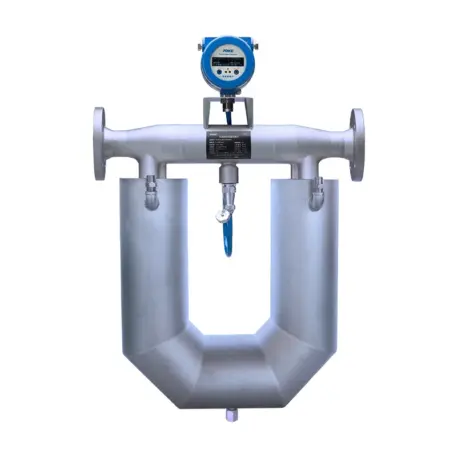

The product
The MFU Coriolis Mass Flow Meter is a high-precision instrument designed for measuring flow and density. By incorporating advanced global technology, it operates based on the Coriolis force principle and MVD™ technology.
It can directly measure the mass flow of fluids in closed pipelines with high accuracy, which is highly significant for process control applications such as energy metering and chemical reactions.
Working principle
When a point mass in a tube performs rotational motion around a fixed point P (rotation center), an inertial force is generated as it moves toward or away from the center.
Considering:
- A particle with mass δm moving at a constant velocity υ inside the tube
- The tube rotating around point P with angular velocity ω
The particle experiences two components of acceleration:
- Normal (centripetal) acceleration αr
- Magnitude: ω²r
- Direction: toward point P
- Tangential acceleration αt (Coriolis acceleration)
- Magnitude: 2ωυ
- Direction: perpendicular to the centripetal acceleration
The force associated with the tangential acceleration is called the Coriolis force: Fc = 2ωυδm
Considering: m = ρ × A × Δχ
We obtain: ΔFc = 2ω × υ × ρ × A × Δχ = 2ω × δqm × Δχ
Where:
- A = cross-sectional area of the pipeline
- δqm = mass flow rate = δm/dt = υρA
For a tube with fixed characteristics, ΔFc depends only on the mass flow rate. Therefore, flow can be determined by measuring the Coriolis force (directly or indirectly).
MFU coriolis mass flow meter
In practice, the sensor does not rotate — it vibrates.
- A curved tube is fixed at both ends
- An excitation force is applied at the center, causing vibration at its natural frequency
Without flow:
- Both sides vibrate in phase (no phase difference)
With flow:
- Coriolis force acts on the fluid
- The two sides of the tube twist in opposite directions
- A phase difference appears, proportional to the mass flow rate
The sensor converts this phase difference into a measurable signal — this is the operating principle of the Coriolis flow meter.
Product features
- Direct measurement of mass flow with high accuracy
- Real-time measurement of fluid density
- MVD™ technology provides:
- Improved signal filtering
- Higher sensitivity and accuracy
- Faster response time
- More reliable measurements
- Flexible system design:
- In many cases, no flow converter is required
- Can be composed of MVD modules and sensors only
- Applications: CNG, LNG, batching systems, density/flow measurement
- High accuracy:
- Mass flow: 0.1% to 0.2%
- Density resolution: 0.002 to 0.02 g/cm³
- Temperature error: < 0.5°C
- Measures density and temperature, enabling concentration calculation (for two-component media)
- Easy installation:
- No requirement for straight pipe sections
- High reliability:
- No mechanical moving parts
- Wide application range:
- One sensor can be used for multiple fluids
Technical parameters
MFU series:
- Diameter: DN3–DN200
- Flow accuracy: 0.1% / 0.15% / 0.2%
- Repeatability: 0.05%
- Density accuracy: ±0.001 g/cm³
- Temperature range: -200°C to 350°C
- Temperature accuracy: ±1°C
- Fluid temperature: -50°C to 300°C
- Ambient temperature: -30°C to 70°C
- Material: 316L, Hastelloy
- Pressure: standard 4 MPa (customizable)
- Protection: IP67
- Explosion-proof: Exd[ib]IICT1~T6Gb
- Outputs: 4–20 mA, frequency, pulse, RS485, HART
MFV Series (Micro-bending):
- DN3–DN100
- Accuracy: 0.1%–0.2%
- Material: 316L, Hastelloy, tantalum
- Fluid temperature: up to 200°C (high-temp customizable)
- Other parameters similar to MFU series
MFC Series (Low Temperature):
- DN3–DN200
- Fluid temperature: -200°C to 100°C
- Accuracy: up to 0.5%
- Material: 316L
MFS Series (Miniature):
- DN1–DN2
- Accuracy: 0.1%–0.2%
- Fluid temperature: -50°C to 150°C
- Material: 316L, Hastelloy alloy