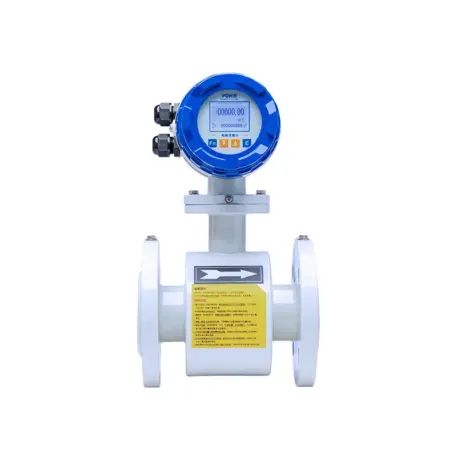

The product
The electromagnetic flow meter consists of two parts: a sensor and a converter. Its operation is based on Faraday’s law of electromagnetic induction. It is a velocity-type meter used to measure the volumetric flow rate of conductive liquids.
In addition to common conductive liquids, it can also measure highly corrosive fluids such as strong acids and alkalis, as well as homogeneous liquid-solid suspensions such as sludge, ore pulp, and paper pulp.
It is widely used in industrial sectors such as petroleum, chemical, metallurgy, textile, pulp and paper, environmental protection, food, as well as in municipal applications, water conservancy projects, and river dredging.
Working principle
According to Faraday’s law, a pair of electrodes is installed on the pipe wall, perpendicular to both the axis of the measuring tube and the magnetic field lines.
When the conductive fluid flows through the pipe, it cuts the magnetic field lines, generating an induced electromotive force (EMF). This EMF is detected by the electrodes.
The EMF value is proportional to the flow rate: E = B × V × D × K
Where:
- E = induced electromotive force
- B = magnetic field intensity
- V = average fluid velocity
- D = distance between electrodes (internal diameter of the pipe)
- K = coefficient related to magnetic field distribution
The sensor transmits the signal E to the converter, which performs digital processing (amplification, filtering, etc.) and displays instantaneous and totalized flow on a backlit LCD screen.
The converter includes:
- 4–20 mA output
- Alarm output
- Frequency output
- RS485 interface
- Support for HART and Modbus protocols
Product features
- Measurement is not affected by changes in density, viscosity, temperature, pressure, or conductivity
- No obstruction inside the pipe → virtually no pressure loss
- Low requirement for straight pipe lengths
- Excellent performance for slurry measurement
- Proper selection of electrode and lining materials:
- High corrosion resistance
- High wear resistance
- Fully digital processing:
- High immunity to interference
- High accuracy
- Wide measurement range
- Switching power supply with low electromagnetic interference (EMI)
- 16-bit embedded microprocessor:
- Fast processing speed
- High accuracy
- Low power consumption
- SMD/SMT technology:
- High circuit reliability
- No moving parts → reduced maintenance
- Range can be configured on-site
- High-definition backlit LCD display
- User-friendly interface
- Digital communication:
- RS485, RS232, HART, Modbus, Profibus-DP (optional)
- Self-diagnosis functions
- Hourly totalization recording
- Bidirectional measurement:
- Forward flow
- Reverse flow
- Net flow
- Power failure event recording (up to 16 events)
- Optional infrared remote operation
Technical parameters
- Standard: Electromagnetic Flowmeter (JBT9248-2015)
- Nominal Diameter:
- PTFE lining: DN10–DN600
- Rubber lining: DN65–DN2000
- Flow Direction: Forward / reverse / net
- Turndown Ratio: 20:1
- Repeatability: ±0.1%
- Accuracy Class: 0.5 / 1.0
- Fluid Temperature:
- Standard rubber: -20°C to +60°C
- High-temperature rubber: -20°C to +90°C
- PTFE: -30°C to +120°C
- High-temperature PTFE: up to +160°C
- Nominal Pressure:
- DN10–25: < 4.0 MPa
- DN32–150: < 1.6 MPa
- DN200–600: < 1.0 MPa
- DN700–2000: < 0.6 MPa
- Velocity Range: 0.1–15 m/s
- Minimum Conductivity: 5 μS/cm
- Outputs:
- 4–20 mA
- Pulse / frequency
- Control
- Communication:
- RS485
- Modbus
- HART
- Profibus-DP
- Power Supply:
- 220 VAC ±15%
- 24 VDC
- Straight Pipe Requirements:
- Upstream: ≥ 5DN
- Downstream: ≥ 3DN
- Connection: Flange (GB/T9119-2010 standard)
- Protection Rating: IP65 (up to IP68 upon request)
- Explosion-proof Rating: Exd [ib] IICT6 Gb
- Ambient Temperature: -25°C to +60°C
- Relative Humidity: 5%–95%
- Power Consumption: < 20 W
Lining materials
Rubber
Neoprene (CR):
- Good corrosion and wear resistance
- Application: tap water, industrial water, seawater
- Up to 60°C
- DN65–2000
Polyurethane (PU):
- Excellent wear resistance
- Poor chemical resistance
- Application: slurries (ore, paper pulp)
- Up to 60°C
- DN25–500
Fluoropolymers:
PTFE (F4):
- Excellent chemical resistance (strong acids, aqua regia, alkalis)
- Up to 120°C
- DN15–1600
FEP (F46):
- Better mechanical strength than PTFE
- Up to 160°C
- DN4–200
PFA:
- Better mechanical performance than FEP
- Up to 180°C
- DN10–300